A Rainy Afternoon, Seen Through a Neighborhood Noticeboard
A neighborhood noticeboard offers a close-looking practice for spotting local creative activity, practical needs, and the interests neighbors share.
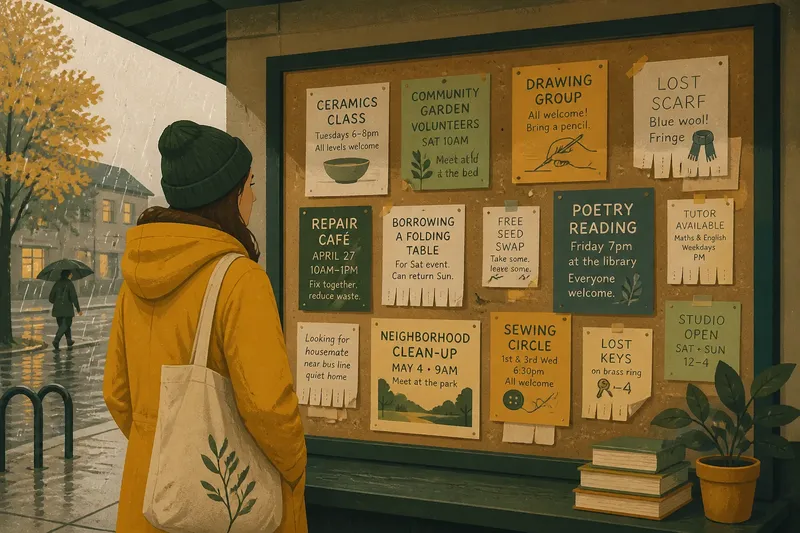
A neighborhood noticeboard turns a rainy afternoon into a small exercise in reading local life. Under a library awning or inside a corner-store window, flyers for a ceramics class, a lost set of keys, and a request for garden volunteers sit within arm’s reach. Look closely and the board becomes more than a place to collect paper: it shows which activities people make room for, and what they need from one another.
The useful approach is simple: observe the board in order, without treating it as a survey of everyone who lives nearby. It is a public surface shaped by the people who post, the person who maintains it, and the limits of the space. A rainy afternoon provides an unhurried reason to pause, read, and notice how practical information and creative invitations share the same patch of cork.
Choose a place to pause
Start with a board you can read without blocking a doorway, shop entrance, or sidewalk. A community center foyer, laundromat, independent grocery, library lobby, or covered bus shelter may have one. Pick a spot where pausing is ordinary, rather than hovering beside a private window or peering into a business.
Rain changes the pace. People tend to tuck under awnings and wait near entrances; paper edges curl, tape loosens, and a plastic cover may fog. Keep your attention on what is publicly displayed. Do not photograph names, phone numbers, addresses, or other personal details. You can read the board without turning its neighbors into material for a record.
Imagine you stop beneath a library awning while rain taps the metal gutter. A hand-lettered invitation to a drawing group hangs beside a notice about a missing scarf. You can notice that drawing and lost property share the board without deciding that one says more about the neighborhood than the other. That restraint is part of the exercise.
Read the whole surface
Before reading individual flyers, take in the board’s overall arrangement. Notice whether it has sections, a frame, a glass door, a community-maintained label, or an informal edge where smaller notes gather. See which papers are pinned high, placed at eye level, overlapped, or tucked beneath other notices. The layout may reflect a rule, a convenient reach, or nothing more deliberate than the last open space.
Then trace a slow path across the surface, from one corner to another. This keeps the eye from jumping straight to the brightest or most polished poster. Handwritten notes can be easy to miss beside a color flyer; a small date or tear-off tab may carry the practical detail that makes a notice usable.
Look for signs of upkeep, too. Fresh tape, a cleared space, or a note asking people to remove old flyers suggests someone tends the board. A crowded edge or a notice covering another may indicate competition for room, but it does not reveal who posted first or why. Treat visible arrangement as a clue, not an explanation.
Separate invitations from notices
Now read the items by what they ask a passerby to do. Some share useful information: a change to a local service, a lost item, a repair café date, or a request for help. Others invite participation in a creative activity, such as a poetry reading, a choir rehearsal, a sewing circle, or an open studio. A single flyer can do both, announcing an event while asking for materials or volunteers.
Notice the language of the invitation. Does it name a skill, welcome beginners, ask people to bring something, or simply give a time and place? Does the design look carefully printed, quickly handwritten, or assembled from scraps? These details show how the organizer presents the activity and what kind of response the notice requests. They do not tell you who feels welcome in practice.
Pay attention to the practical notices without treating them as background clutter. A request for a borrowed folding table may reveal the work involved in running an event. A notice about a neighborhood clean-up can join a shared task to a clear place and time. Creative activity often depends on these ordinary arrangements, even when the poster foregrounds a finished performance or display.
Notice what repeats
After reading individual items, look for recurring interests. Several notices may point to making things, sharing food, caring for a community garden, learning a language, or organizing a local event. Repetition suggests that more than one person or group is making room for that activity on this board. It does not establish how widely the interest is shared beyond the people who use the board.
Look for connections between notices as well as repeated topics. A music event and a request for folding chairs may be unrelated, or the practical request may support an activity posted nearby. A drawing group and an art-supply swap might share a subject without sharing an organizer. Unless the notices say so, leave those links as possibilities rather than turning them into a neat story.
One useful way to keep the reading grounded is to distinguish what the board states from what it prompts you to wonder. “Open to beginners” is printed information. “New residents might find this group welcoming” is an inference. Keep the two separate, especially when a flyer’s cheerful design tempts you to supply the missing details.
What can the board tell you?
What belongs on a neighborhood noticeboard?
Usually, the board holds a mix of local events, services, requests, classes, lost-and-found notes, and community announcements. The exact mix depends on who can post and how the space is maintained.
How can I spot creative activity?
Look for invitations to make, perform, learn, exhibit, or share something, along with the materials and participation details they name. A workshop notice may reveal more about the activity than a polished poster that lists only a title and venue.
Does a busy board represent the whole neighborhood?
No. It represents the people and organizations that use that particular surface, within its available space and posting customs. Some neighbors may not know it exists, may prefer another channel, or may have no reason to post.
Should I take a photo or copy down details?
For a personal reminder, copy only the event details you need, and respect any posted request about photography or removal. Avoid recording private contact information or sharing images that expose it.
Leave with one detail
Before moving on, choose one specific detail that changed how you read the board. It might be the hand-drawn map to an event, the note asking people to bring scrap fabric, or the way several different groups leave open invitations. Naming one detail keeps the afternoon attentive without turning every scrap of paper into evidence.
If a notice interests you, use the information it gives you: check the named venue, date, and contact route, or ask the staff responsible for the board whether the posting is current. Posting rules, removal requests, and event details can depend on the venue, so follow what the board or its host says.
A neighborhood noticeboard rewards a second look because its creative invitations sit beside the ordinary logistics that let people gather. The rain may keep you under the awning for another moment; use it to notice who is being invited to make something, what help the invitation asks for, and what the board leaves unsaid. That is a modest reading of a city, but a more honest one than asking a handful of flyers to speak for everyone.