Why a Bench Changes the Feel of a Public Square
Why a bench changes the feel of a public square: read its layout to tell whether a spot invites a quiet pause, people-watching, or conversation.
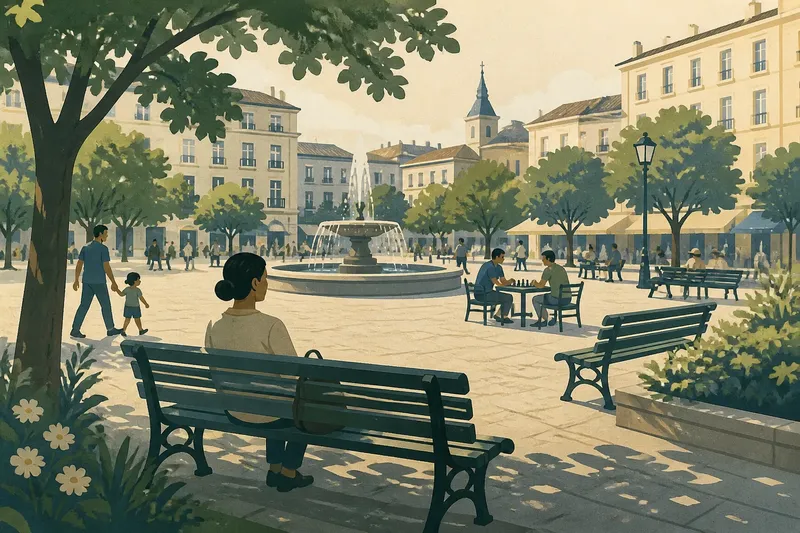
A bench changes the feel of a public square by deciding what a person can comfortably do there. Its direction, distance from other seats, and relation to paths can make a pause feel private, a view feel shared, or a conversation feel easy to join. The useful question is not simply whether the square has seating. It is what kind of attention the seats make possible.
That distinction matters if you are choosing where to sit, assessing a square for a visit, or trying to understand why one corner feels sociable while another stays quiet. Read the benches as small pieces of public choreography. They do not dictate behavior, but they make some choices easier than others.
Read the bench layout
Start with the seat’s orientation. A bench facing a fountain, garden bed, play area, or broad view gives its occupant something to look at without requiring anyone else’s company. A bench facing the center of a square turns the whole space into a scene. A bench facing another bench makes conversation more plausible, though not compulsory.
Then notice where the seat sits in relation to movement. A place beside a main path offers passing activity and easy access. It may also make a person feel on display or leave little room for others to pass. A seat set behind a tree, planter, or low wall can feel more sheltered, while still keeping the square in view. The difference is often one of exposure, not scenery.
Distance matters as much as direction. Seats close enough for voices to carry can support an exchange between companions or strangers. A cluster with room between its benches gives groups a choice: sit together, or occupy separate edges of the same area. A lone bench may suit someone who wants company at a distance, not an invitation to talk.
Look for the gaps, too. A square can contain many benches and still offer few comfortable places to stop if every seat is directly in a traffic line, facing a blank wall, or arranged so closely that people must negotiate for personal space. Seating is useful when it lets a visitor choose a relation to the square, not merely a place to put their bag.
Choose by your situation
If you want a brief pause between errands, choose a bench near a clear route but outside the path itself. You can sit down without making a detour, keep track of where you are going, and leave without asking anyone to move. A seat at the edge of a planted area often works well because it gives the pause a view without placing you in the middle of foot traffic.
If you want to watch the square, look for a seat with a broad view and a stable foreground. Facing a fountain, chess tables, a playground, or a crossing gives the eye a natural focus. A position slightly off-center can be more comfortable than a prominent central bench: you can see activity without feeling like part of the display.
If you want to talk, choose seats that face one another or meet at an angle. Directly opposite benches make it easier to hear, while angled seats can keep conversation relaxed and leave a shared view. If you are meeting someone who may arrive separately, a visible bench near a recognizable feature is easier to find than a tucked-away seat with no clear landmark.
If you need a quieter spot, look for a seat that is screened from the busiest route but not sealed off from the square. A tree canopy, planter, or low boundary can soften the feeling of exposure. Avoid assuming that the farthest corner is automatically calm; service doors, delivery access, or a narrow passage can make a remote seat feel less settled than a busier edge.
If you are bringing a stroller, a mobility aid, or a large bag, pay attention to the approach and the space beside the bench. A seat may be technically present but awkward to reach if its surrounding paving is narrow or cluttered. An open end, level path, and nearby turning room can matter more than whether the bench has a particularly attractive view. For specific access needs, local conditions and the design of the square will determine what is usable.
If you are meeting a group, a set of benches around a shared feature can be more practical than one long seat. People can arrive at different times and settle without making everyone shift. For a one-to-one conversation, that same arrangement may feel scattered; a pair of seats close enough to speak comfortably is usually more fitting.
Notice the social cues
Bench design sends quiet signals. A long, uninterrupted seat can accommodate a range of group sizes, but it may make a stranger’s approach feel more direct. Separate seats create clearer boundaries and give people an easy way to sit near one another without sharing an armrest. Neither design is inherently more welcoming. The square’s users and the placement of the seats shape how those options are read.
Armrests and dividers can help people settle into a defined space or make it easier to rise. They can also limit how many people fit and interrupt a group’s conversation. Treat these details as part of the seat’s social arrangement rather than as decoration. A bench that works for a solo visitor may be less convenient for a family or a group with mixed mobility needs.
Nearby activity changes the meaning of a seat. A bench close to a café entrance may support people-watching, but it can also sit in the way of customers and passersby. A seat beside a game table may make conversation with other visitors easier, though the game itself can dominate the sound and view. Consider what occupies the area at the time you expect to use it; a square can feel different during a market, a school pickup, or a quiet afternoon.
Imagine you have twenty minutes before meeting a friend and want to watch the square without being pulled into conversation. A bench facing a fountain, set just beyond the main crossing, fits better than a pair of seats facing one another beside a café door. The first gives you a view and a straightforward exit. The second makes arrival and conversation more likely, which is useful for a different purpose.
Make a simple observation
To notice what a bench encourages, watch the arrangement rather than judging the square as a whole. Pick one seat and ask three questions: What can a seated person see? Who can approach without crossing directly in front? Where could a companion sit? The answers reveal whether the bench favors observation, a quick stop, or exchange.
Then compare it with a nearby seat. If one faces the center while another faces a garden edge, notice whether the difference changes how exposed each position feels. If benches form a loose cluster, see whether there is a clear route through it or whether people must pass between seated visitors. You do not need to count occupants or infer what they are thinking. Visible layout is enough to make a useful distinction.
A small sketch can help when you are comparing two squares. Mark the benches, paths, planted areas, entrances, and obvious activity points. Add arrows for the direction each bench faces. The drawing need not be precise; it should show whether seating is tucked away, exposed, grouped, or arranged toward something worth watching.
Questions about square benches?
Which bench is best for people-watching?
Choose a seat with a clear view of ordinary activity, such as a fountain, central path, or play area. A position slightly away from the main route usually lets you observe without becoming an obstacle.
Which arrangement suits a conversation?
Look for seats facing one another or set at a comfortable angle, with enough room to speak without blocking a path. A shared view can also help if the conversation has pauses.
Why do some benches feel exposed?
A bench can feel exposed when it faces the busiest part of the square, sits in a direct line of travel, or has no nearby edge or planting to create a sense of shelter. The same openness may appeal to someone who wants a clear view and easy access.
Does a bench need a backrest?
A backrest can make a longer pause more comfortable for some visitors, while a backless seat may allow people to sit from either side or turn toward different views. The better choice depends on how the seat is used and who needs to use it.
When the layout falls short
Sometimes none of the benches fits your purpose. A square may offer a fine view but only from a seat beside a busy entrance, or it may have quiet corners with no clear route for someone who needs an accessible approach. In that case, identify the compromise before settling: perhaps you want the view more than privacy, or a sheltered position more than a quick exit.
For a short visit, the best available seat may be the one that makes leaving easy. For a longer conversation, it may be worth choosing a less scenic spot where people can hear each other. If you are evaluating a square for a group, look beyond the most photogenic bench and consider how people will arrive, sit, turn, and pass one another.
Why a bench changes the feel of a public square becomes clear when you match its arrangement to the activity you want. Facing outward favors watching; facing another seat makes conversation easier; a sheltered edge supports a quieter pause. The next time you cross a square, notice which choices its benches offer—and whether there is room for someone to choose differently.