The Myth of One Correct Way to Queue
Queueing customs change with the setting. Learn to read local cues, recognize different ways of claiming a place, and avoid mistaking confusion for rudeness.
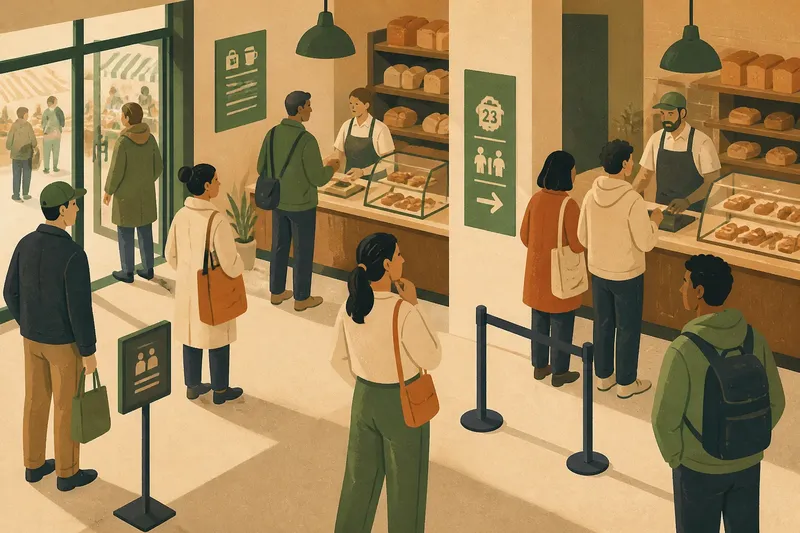
Queueing customs change with the setting, and the line at a city bakery may work differently from the crowd boarding a bus. The useful skill is not enforcing one universal rule; it is noticing how people are organizing themselves before you join in.
What counts as a queue?
A queue is a shared way of ordering access, but it does not always look like a single row. People may stand in a line, gather around a service point, take numbered tickets, or wait near a doorway while staff call the next person. The arrangement depends on the service and the space as much as on local habit.
A narrow counter often makes a visible line practical. At a crowded market stall, customers may form a loose cluster and remember who arrived before them. In a transit station, the painted marks on the floor can suggest where to stand, while the doors and arriving vehicles determine where the actual boarding order begins.
It helps to distinguish the queue’s form from its ordering rule. A group can look untidy yet still have an agreed sequence. Conversely, a neat line can leave people unsure whether it continues around a corner or ends at a second register.
Why do queueing rules differ?
Queueing rules differ because places solve different practical problems. A single checkout can serve people one after another. A busy food counter may need several staff members taking orders at once, which makes one line harder to maintain. At a bus stop, passengers may gather near the door rather than form a strict line because the vehicle’s arrival changes the layout.
Space and timing also shape expectations. A small shop may have an obvious entrance and counter, while a street festival spreads its stalls across a plaza. Some settings use a ticket dispenser or an appointment list to make order visible; others rely on people remembering who was waiting. These systems can look like local quirks, but they often answer a specific logistical need.
Customs vary within the same city, too. A pharmacy, a coffee cart, and a public service desk may each have distinct signals for who is next. Familiarity with one does not automatically transfer to the others. A regular customer may know that a shop’s queue begins beside the display rack, while a newcomer sees only an unmarked patch of floor.
How can you read local cues?
Start with the service point, not the nearest cluster of people. Look for a ticket machine, floor markings, a sign, a numbered display, or a staff member directing customers. Then notice whether people are arranged in a row, waiting beside separate counters, or watching a shared entrance.
Watch what happens when service moves forward. If the person who has just been helped leaves and the person behind them steps up, that is a useful clue. If several customers approach different staff members, the place may be operating multiple informal lines. If people glance toward a doorway or an employee before moving, they may be waiting for a call rather than claiming a place by standing closest.
Say you arrive at a crowded bakery and see several customers near two counters. Imagine one employee serves the left counter while another prepares orders on the right, and customers step forward only when their chosen employee is free. Rather than joining the densest group, you could pause where you can see both counters, observe who is being served, and ask, “Is this one line, or does each counter have its own?” The expected observable result is a clearer sense of where to wait, without forcing the group to explain its customs at length.
When the system remains unclear, a brief, neutral question is usually more useful than a confident guess. “Who’s next?” or “Does the line start here?” lets someone clarify the arrangement. Keep the question ordinary; an ambiguous queue is a small problem, not a public hearing.
What if there is no visible line?
No visible line does not necessarily mean there is no order. People may be waiting by arrival time in a loose group, using a ticket, or expecting staff to call names. Look for signs of attention: who is facing the counter, who has a ticket in hand, and whether customers step forward when called.
If a group is clustered around a service point, avoid treating physical closeness as proof that someone has been skipped. The person nearest the counter may be placing an order, asking a question, or collecting something already prepared. A calm check with the person who appears to be coordinating service can resolve the uncertainty without making an accusation.
When no employee is available, ask the people waiting rather than selecting a position at random. A simple “Are you all waiting for the same counter?” can reveal whether there is one shared order or several. If nobody seems certain, standing where others can see you and leaving room for people to pass is a sensible temporary choice.
Is it rude to ask who is next?
Usually, asking who is next is not rude if the question is brief and directed to the group or staff. It signals that you intend to follow the existing order rather than assume your place. Tone matters: a neutral question invites information, while a complaint can suggest that someone has already done something wrong.
There are moments when asking is unnecessary. If a ticket display calls your number, follow that system. If a sign explains where the line begins, use it. In a setting where one person is clearly being served and others stand behind them, you can join at the end instead of asking everyone to confirm the obvious.
Should you correct someone who cuts in?
First check whether the apparent cut is actually a breach. The person may be joining a companion, responding to a staff instruction, collecting an order, or using a separate service point. A short pause to observe can prevent a needless confrontation over a queue whose rules you have not yet read.
If someone seems to have moved ahead of people who were waiting, a calm clarification is often enough: “I think there are a few people waiting here.” You can also ask staff to direct the line, especially in a workplace or venue that manages the service. Avoid blocking the person or turning the disagreement into a contest of volume. If the setting is tense, crowded, or otherwise uncomfortable, let staff handle it and keep your distance.
Does first come, first served always apply?
No. First come, first served is common, but it is not the only way a public service assigns turns. Appointments, numbered tickets, priority arrangements, separate counters, and staff instructions can all change the order. The visible position of a person in a room may not reflect their place in the service system.
For instance, a person with an appointment may be called before someone who arrived earlier, or a ticket display may call numbers out of the order they were collected. That does not automatically mean the system has failed. Check the sign or ask staff how turns are being assigned; where the answer depends on the venue’s instructions or local rules, follow those directions.
Queueing is a small piece of public cooperation, not a universal choreography. Reading the setting means looking for its signals, allowing room for uncertainty, and asking a clear question when the order is genuinely unclear. Once you know how this queue works, you can take your place without mistaking a different custom for bad manners.
The next time a line appears to have no beginning, look for the tool or person that makes the order visible: a ticket machine, a counter, a staff member, or simply the people who have been waiting. That clue is usually more helpful than importing the rules from the last place you stood in line.