The Front Room and the Changing Idea of Urban Hospitality
The front room’s changing role shows how urban hospitality can move from formal visits to everyday sociability, without requiring a separate room.
The front room once let a household receive visitors without bringing them through the working parts of the home. Today, in many city apartments, the same room may hold the sofa, laundry rack, desk, and the people who drop by. The front room’s changing role is not simply a story of rooms disappearing. It reflects a shift in what urban hospitality asks of a home: ceremony, privacy, or the willingness to make ordinary life shareable.
There is no single modern arrangement. Some households preserve a distinct space for guests; others use one flexible room for nearly everything; still others treat the kitchen or dining area as the natural place to gather. Each approach suits a different household and a different idea of visiting. The useful question is not which arrangement looks most welcoming, but what kind of contact the household wants to make easy.
The formal reception room
A separate front room draws a clear line between visitors and domestic work. The door opens onto a space arranged for conversation, and guests need not pass a bedroom or see a pile of mail on the kitchen counter. In a larger apartment or a home with several rooms, this boundary can make visits feel deliberate without making the rest of the household permanently presentable.
The arrangement suits people who host scheduled visits, need a quiet place to speak, or value a visible distinction between public and private life. It may be useful when relatives, neighbors, or clients visit regularly and the household wants to welcome them without turning the whole home into a reception area.
But a room held apart can also become a room used rarely. A carefully kept sofa and untouched side table do little for daily sociability if household members hesitate to enter. In that case, the front room performs hospitality as display: it says that visitors are expected, while offering little evidence that anyone lives there.
Small signals can soften that effect. A reading lamp, a basket for children’s books, or a chair turned toward the window makes the room usable between visits. The point is not to remove its guest function. It is to keep hospitality from requiring the household to maintain a miniature waiting room.
The shared living room
In a compact apartment, the living room often has to host both residents and visitors. A sofa faces the television, a desk occupies one wall, and the same table may hold dinner, a laptop, and a guest’s cup. This arrangement treats hospitality as an extension of ordinary life rather than a separate performance.
It suits households that prefer informal drop-ins, share space comfortably, or do not have an extra room to reserve. Guests see more of the home’s daily rhythm, and residents do not need to move a gathering through a formal threshold before it can begin. The trade-off is that privacy becomes a matter of small choices: where coats go, what surfaces are cleared, and whether the television stays on.
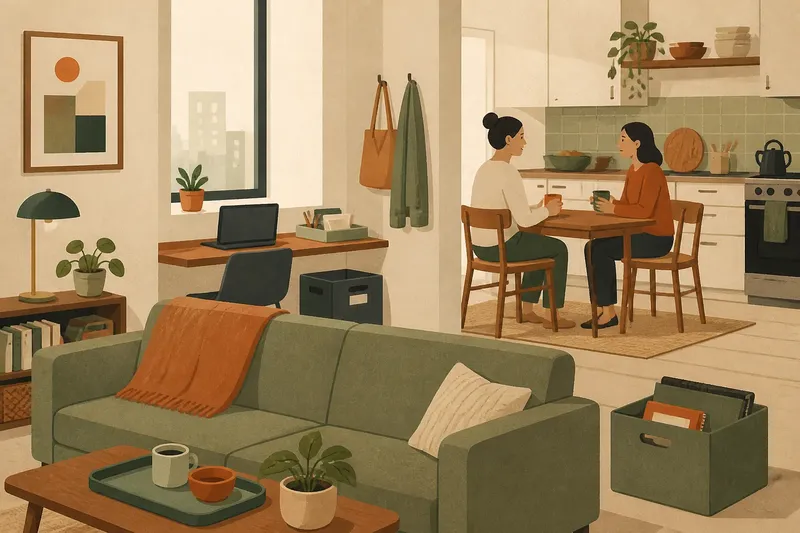
Imagine a tenant who works at a small desk beside the living-room window and expects a neighbor for tea after work. She clears the desk into a shallow tray, moves the tray to a shelf, and sets two mugs on the table. The expected result is not a transformed room, but a clear place to talk while the rest of the room remains recognizably hers.
This kind of hospitality benefits from a few objects that can move rather than a full room reset. A lidded storage box can hold work materials; folding chairs can be brought out when needed; a tray can gather cups without claiming permanent territory. The choices are modest, but they make it easier to welcome someone without pretending that urban domestic life is free of unfinished tasks.
The kitchen as guest room
Some households receive visitors in the kitchen or dining area, even when a living room exists. Food and conversation share the same surface, and the host can stay involved in preparing a meal rather than disappearing to another room. This often makes a visit feel less like an appointment and more like participation in the household’s routine.
The kitchen suits people whose visits center on eating, cooking, or practical conversation. It can work well for neighbors who stop in briefly, family members who help with a meal, or friends who prefer to sit near the kettle rather than arrange themselves around a sofa. A small dining table can also make conversation easier for people who find a face-to-face interview across a coffee table oddly official.
Its limitations are plain. Cooking smells, limited seating, and the presence of dishes may shape the visit more than the host intends. Some guests may not feel comfortable in a working kitchen, while the host may want to keep food preparation private. A kitchen gathering is welcoming when participation is optional, not when every visitor is quietly drafted into chopping onions.
Where the kitchen is also the main social room, a clear place to sit matters more than spotless counters. One or two chairs that do not block a route through the room can invite someone to stay. If the available space makes that awkward, the household may prefer a brief kitchen hello followed by a move to another shared area.
Choosing a room?
Does a front room need to be formal?
No. A separate room can offer privacy without being reserved for special occasions. Regular use by household members keeps it comfortable and makes receiving guests less like opening a display case.
What if there is no spare room?
Use the room where conversation already happens, then make one surface or seating area easy to share. A defined place for bags, cups, or work materials can help without requiring the entire apartment to be cleared.
Should guests see the working parts of home?
That depends on the household’s comfort and the purpose of the visit. Shared domestic detail can make an informal gathering feel relaxed, but visitors do not need access to private rooms or personal paperwork to feel welcome.
Which arrangement suits frequent drop-ins?
A shared living room or kitchen usually makes casual visits simpler because it is already part of daily life. A separate reception room may suit better when visits require privacy or a quieter boundary.
Hospitality by invitation
The room itself does not determine whether a home feels hospitable. The arrangement matters because it tells residents and visitors what kinds of contact are expected. A formal front room can make a quiet conversation possible; a shared living room can make an unplanned visit feel ordinary; a kitchen can invite participation in the household’s routine.
Choose by looking at how visits actually happen. If they are scheduled and private, preserve a clear guest space. If they are casual and frequent, favor a room already used each day. If food is the center of gathering, let the kitchen or dining area do the work, while leaving guests free to sit without joining the preparation.
The front room’s changing role offers a practical lesson about city life: hospitality does not require a room kept untouched for other people. It requires a place where a visitor can understand how to arrive, sit, and take part. Sometimes that place is a formal room with a closed door. Sometimes it is the chair beside the desk, briefly cleared of its weekday duties.